
How to Turn Cold Audiences Into Buyers Using Retargeting & Value Ladders


Imagine walking into a store, glancing at a product for a few seconds, and leaving without buying it. A few days later, the store owner remembers exactly what caught your attention, sends you helpful information about it, offers a useful guide, and eventually gives you an irresistible deal that feels perfectly timed.
That, in essence, is what modern digital marketing should do.
The reality is that most people won't buy the first time they discover your business. Research consistently shows that consumers need multiple interactions with a brand before they feel confident enough to make a purchase. Whether you're a small business owner, a digital influencer, or a marketing professional, understanding this buying journey is the difference between campaigns that burn through advertising budgets and campaigns that consistently generate profitable sales.
This is where How to Turn Cold Audiences Into Buyers Using Retargeting & Value Ladders becomes one of the most valuable strategies in your marketing toolkit.
Instead of expecting strangers to trust your business immediately, retargeting allows you to reconnect with people who have already shown interest. At the same time, a well-designed value ladder gradually increases customer commitment by providing increasing levels of value before asking for larger purchases.
When these two strategies work together, they create a marketing system that builds trust, nurtures relationships, and significantly improves conversion rates.
In this comprehensive guide, you'll learn how to combine retargeting with value ladders to create a scalable sales engine that works across platforms like Google Ads, Meta Ads, YouTube, LinkedIn, TikTok, and email marketing. You'll also discover how to optimize your strategy for Google's search results as well as AI-powered answer engines like ChatGPT, Gemini, Claude, Perplexity, and Google AI Overviews.
What Is a Cold Audience?
A cold audience consists of people who have never interacted with your business before. They may fit your ideal customer profile, but they don't yet know who you are, what you offer, or why they should trust you.
Think of it like introducing yourself at a networking event. You wouldn't immediately ask a stranger for a large business deal. Instead, you would start a conversation, establish common interests, demonstrate expertise, and build rapport over time.
Digital marketing works the same way.
Examples of cold audiences include:
People discovering your website through Google Search.
Users seeing your Facebook or Instagram advertisements for the first time.
Viewers watching one of your YouTube videos after searching for a solution.
Professionals finding your LinkedIn content through hashtags or recommendations.
Visitors arriving from blog articles or guest posts.
These audiences are aware of a problem but aren't yet convinced that your business is the best solution.
Why Cold Audiences Rarely Buy Immediately
One of the biggest mistakes businesses make is expecting instant conversions.
Consumers today have more choices than ever before. Before making a purchasing decision, they often:
Compare multiple competitors.
Read customer reviews.
Watch demonstration videos.
Search for pricing information.
Read FAQs.
Ask AI tools like ChatGPT or Gemini for recommendations.
Check social proof across multiple platforms.
This research process creates a longer buying journey than many businesses anticipate.
Trust isn't built in seconds—it is earned through consistent, valuable interactions.
This is precisely why How to Turn Cold Audiences Into Buyers Using Retargeting & Value Ladders has become an essential strategy for businesses of every size.
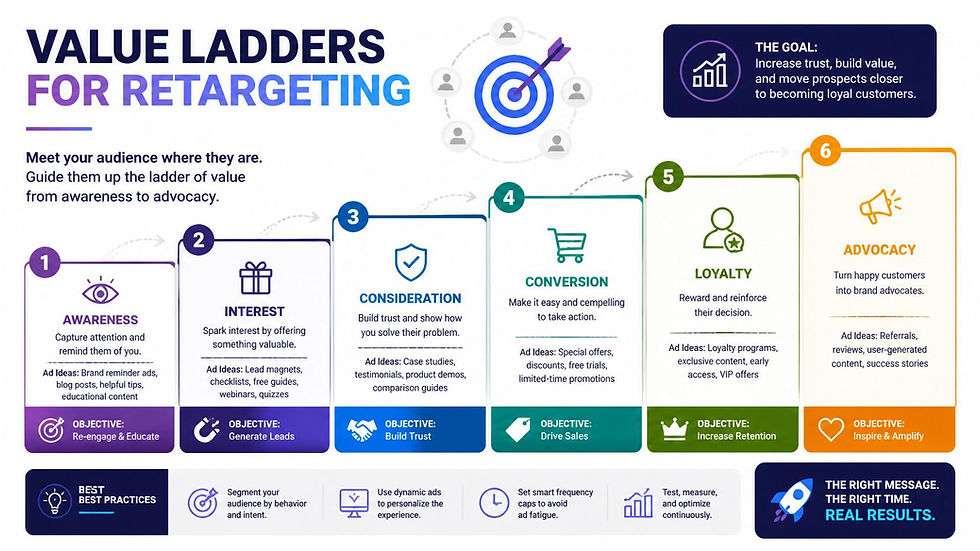
Understanding the Modern Customer Journey
Instead of viewing marketing as a single advertisement leading directly to a sale, successful marketers understand that customers move through several psychological stages.
Stage 1: Awareness
The customer discovers your brand for the first time.
At this point, they're simply learning that your business exists. They may read a blog article, watch a short-form video, discover your social media page, or click on a search result.
Your goal isn't to sell immediately.
Your goal is to educate and earn attention.
Stage 2: Interest
The customer becomes curious.
They begin exploring your content, visiting multiple pages on your website, subscribing to your newsletter, or following you on social media.
They want to know:
Can this business solve my problem?
Is this company trustworthy?
Do they understand my needs?
Stage 3: Consideration
The customer starts comparing options.
They evaluate your competitors, read testimonials, examine pricing, and search for additional information.
Many businesses lose prospects at this stage because they stop communicating after the first interaction.
Retargeting ensures your business remains visible throughout this decision-making process.
Stage 4: Purchase
Only after enough trust has been established does the customer become ready to buy.
Notice how purchasing is the final step—not the first.
What Is Retargeting?
Retargeting is a digital advertising strategy that allows businesses to reconnect with people who have already interacted with their website, advertisements, social media pages, or content.
Instead of continuously paying to attract entirely new visitors, retargeting focuses on individuals who have already expressed interest.
Imagine someone visits your online store, browses your products for five minutes, adds an item to their cart, but leaves without completing the purchase.
Without retargeting, that potential customer may never return.
With retargeting, you can remind them about the product they viewed, answer common objections, showcase customer reviews, offer educational content, or present a limited-time promotion that encourages them to complete the purchase.
This strategy keeps your brand top of mind during the buying process.
Why Retargeting Works So Well
Retargeting is effective because it aligns with human psychology.
People naturally trust what feels familiar.
Marketing experts often refer to this as the "mere exposure effect." The more frequently someone encounters a brand in a positive context, the more comfortable they become with it.
Retargeting helps build familiarity without being intrusive—provided it delivers genuine value rather than repeatedly showing the same sales advertisement.
Some of the biggest benefits include:
Higher conversion rates compared to cold advertising.
Lower customer acquisition costs.
Better return on advertising spend.
Increased brand recognition.
Stronger customer trust.
Improved sales funnel performance.
More efficient use of marketing budgets.
For many businesses, retargeting campaigns outperform standard prospecting campaigns because the audience has already demonstrated buying intent.

What Is a Value Ladder?
While retargeting keeps your business visible, a value ladder gives customers a logical path toward increasingly valuable purchases.
Rather than asking someone to buy your premium service immediately, you gradually deepen the relationship.
A typical value ladder looks like this:
Helpful blog article
Free checklist or guide
Email newsletter
Low-cost digital product
Core product or service
Premium package
High-ticket consulting, coaching, or membership
Each step builds confidence while reducing perceived risk.
For example, a digital marketing agency might structure its value ladder like this:
Free SEO blog.
Website audit checklist.
Free webinar.
₹999 SEO audit.
Monthly SEO package.
Full digital marketing retainer.
Enterprise consulting services.
Each offer naturally prepares the customer for the next.
Instead of selling aggressively, you're increasing trust while continuously delivering value.
This is why How to Turn Cold Audiences Into Buyers Using Retargeting & Value Ladders is such a powerful long-term growth strategy. Retargeting brings prospects back, while the value ladder ensures that every interaction moves them one step closer to becoming a loyal customer.

Why Retargeting and Value Ladders Work Better Together
Think of retargeting as the GPS that keeps guiding people back to your business.
Think of the value ladder as the staircase that helps them climb toward bigger purchasing decisions.
Using only retargeting is like repeatedly inviting someone into your store without giving them a reason to stay.
Using only a value ladder is like building a beautiful staircase but forgetting to invite anyone inside.
When combined, these strategies create a complete customer acquisition system that nurtures prospects from their very first interaction to becoming repeat buyers and enthusiastic brand advocates.
In the next section, we'll explore how to build high-performing retargeting campaigns, segment audiences effectively, design irresistible offers at every stage of your value ladder, and create automated marketing funnels that consistently convert cold traffic into paying customers.
Why Most Businesses Fail at Retargeting (And How to Avoid the Same Mistakes)
Retargeting is one of the highest ROI marketing strategies available, yet many businesses still see disappointing results. The problem usually isn't the technology—it's the strategy.
Many brands assume that showing the same advertisement repeatedly will eventually convince someone to buy. In reality, repeated exposure without added value often creates ad fatigue rather than trust.
If you're serious about learning How to Turn Cold Audiences Into Buyers Using Retargeting & Value Ladders, avoiding these mistakes is just as important as building your funnel.
Mistake #1: Selling Too Soon How to Turn Cold Audiences Into Buyers Using Retargeting & Value Ladders
Imagine meeting someone for the first time and immediately asking them to marry you.
That's exactly what many ads do.
A visitor lands on your website, spends thirty seconds reading a blog, and the next thing they see is:
"BUY NOW! LIMITED OFFER!"
The visitor barely knows you.
Instead, gradually increase commitment.
A smarter sequence looks like this:
Read a helpful blog.
Download a free checklist.
Watch a tutorial.
Attend a webinar.
Purchase a low-cost offer.
Upgrade to premium services.
Every step earns trust.
Mistake #2: Showing Everyone the Same Ad
Not every visitor behaves the same way.
Someone who watched 95% of your YouTube video is far warmer than someone who bounced off your homepage after ten seconds.
Treating them identically wastes advertising budget.
Instead, segment audiences based on intent.
Examples include:
Homepage visitors
Product page visitors
Blog readers
Video viewers
Cart abandoners
Previous customers
Newsletter subscribers
Webinar attendees
Each audience deserves different messaging.
Mistake #3: Ignoring Frequency
People need reminders.
They don't need harassment.
If someone sees your advertisement fifteen times in two days, irritation replaces curiosity.
Monitor:
Frequency
Reach
CTR
Conversion Rate
Cost per Acquisition
If frequency keeps rising while conversions drop, refresh your creatives.
Mistake #4: No Educational Content
Retargeting shouldn't only sell.
It should teach.
Examples include:
Tips
Mini case studies
Before-and-after results
Behind-the-scenes videos
FAQs
Customer success stories
Industry insights
Educational retargeting builds authority while keeping your brand top of mind.
Mistake #5: No Value Ladder
Many businesses offer only one thing:
Buy.
If people aren't ready, there's nowhere else to go.
A value ladder gives every visitor an appropriate next step.
Instead of losing them forever, you move them one step closer to becoming customers.
Building a High-Converting Value Ladder
The phrase How to Turn Cold Audiences Into Buyers Using Retargeting & Value Ladders becomes much easier when your offers are organized into a logical progression.
Think of climbing stairs.
People rarely jump from the ground floor to the rooftop.
They climb one step at a time.
Your customers behave the same way.
Step 1 — The Free Value Stage
Goal:
Build trust.
Possible offers include:
Free checklist
Ebook
Guide
Template
Webinar
Free audit
Free consultation
Quiz
Calculator
Resource library
The visitor exchanges an email address for genuine value.
Now they're no longer anonymous.
Step 2 — The Low-Ticket Offer
Now the relationship begins.
Price examples:
₹199
₹499
₹999
₹1,999
This product should solve one specific problem quickly.
Examples include:
For a digital marketing agency:
SEO audit
Google Ads audit
Landing page review
Website speed report
For creators:
Mini course
Prompt library
Design templates
For coaches:
One-hour consultation
Starter workbook
Planning session
The goal isn't massive profit.
The goal is turning a visitor into a customer.
Psychologically, that's a huge milestone.
Step 3 — Core Offer
Now trust exists.
This is where your main revenue comes from.
Examples:
SEO services
Website development
Digital marketing retainers
Coaching program
Membership
Software subscription
Consulting package
By now, purchasing feels natural rather than risky.
Step 4 — Premium Offer
Happy customers are your best prospects.
Offer premium solutions like:
VIP consulting
Annual retainers
Done-for-you implementation
Enterprise services
Mastermind groups
High-ticket coaching
Private workshops
Selling becomes easier because credibility has already been established.
Designing Retargeting Campaigns for Every Funnel Stage
Retargeting isn't a single campaign.
It's a conversation that evolves.
Let's see how messaging changes as trust grows.
Stage 1: Cold Visitors
Objective:
Awareness.
Messaging:
Educational blogs
Helpful videos
Industry statistics
Problem awareness
Beginner guides
CTA:
"Learn More"
Stage 2: Interested Visitors
Objective:
Build trust.
Messaging:
Testimonials
Case studies
Success stories
Comparison guides
FAQs
CTA:
"Download Free Guide"
Stage 3: Warm Leads
Objective:
Encourage action.
Messaging:
Limited-time bonuses
Free consultation
Live demo
Webinar invitation
Product walkthrough
CTA:
"Book Your Demo"
Stage 4: Cart Abandoners
Objective:
Remove hesitation.
Messaging ideas:
Still thinking?
Need help deciding?
Here's what other customers achieved.
Have questions?
Limited stock.
Limited-time bonus.
Sometimes a reminder alone dramatically improves conversions.
Stage 5: Existing Customers
The sale isn't the end.
It's the beginning.
Retarget customers with:
Upsells
Cross-sells
Tutorials
Customer-only discounts
Referral programs
Loyalty rewards
Customer retention is often far more profitable than constant customer acquisition.

The Psychology Behind Why Retargeting Works
Understanding human behavior is the secret behind How to Turn Cold Audiences Into Buyers Using Retargeting & Value Ladders.
Retargeting succeeds because it aligns with the way people naturally make decisions—not because it forces them into making one.
The Mere Exposure Effect
Psychologists have long observed that people tend to develop a preference for things they encounter repeatedly.
A brand seen once is easy to forget.
A brand encountered several times in useful, relevant contexts begins to feel familiar and trustworthy.
The key word is relevant. Familiarity should come from helpful interactions, not repetitive interruptions.
Social Proof Reduces Risk
Buying always involves uncertainty.
Potential customers wonder:
Will this actually work?
Is this company reliable?
Have other people succeeded with it?
Retargeting campaigns that include customer testimonials, case studies, reviews, or measurable results help answer those questions before the prospect even asks them.
Seeing real success stories reassures buyers that they're making a safer decision.
Consistency Builds Commitment
Once someone takes a small action—such as downloading a guide or subscribing to your newsletter—they're often more willing to take the next logical step.
That's why value ladders are so effective.
Each small commitment makes the next one feel more natural, gradually moving a cold visitor toward becoming a loyal customer.
Advanced Retargeting Strategies That Maximize ROI
Once you've mastered the basics, it's time to move into advanced tactics that can significantly improve your return on ad spend (ROAS). Businesses that truly understand How to Turn Cold Audiences Into Buyers Using Retargeting & Value Ladders don't simply retarget—they personalize every interaction based on where the prospect is in the buying journey.
Sequential Retargeting
Instead of showing the same ad repeatedly, create a sequence that tells a story.
For example:
Day 1–3: Introduce the problem.
Day 4–7: Share educational content or a helpful guide.
Day 8–12: Showcase customer testimonials.
Day 13–18: Demonstrate your product or service in action.
Day 19–25: Present a limited-time offer or bonus.
Each touchpoint builds trust and answers a new objection, making the buying decision feel natural rather than forced.
Dynamic Product Retargeting
For eCommerce businesses, dynamic ads are incredibly powerful.
If a visitor viewed a particular product but didn't purchase it, show that exact product again, along with:
Similar products
Best-selling alternatives
Complementary products
Limited-time discounts
Customer reviews
This keeps your brand relevant while reminding shoppers of what originally caught their attention.
Cross-Platform Retargeting
Consumers rarely stay on one platform.
They may:
Discover your brand on Instagram.
Watch your YouTube video later.
Search your business on Google.
Visit your website from LinkedIn.
Finally purchase after seeing a Google Display ad.
Maintaining consistent messaging across platforms creates a seamless customer experience and reinforces brand trust.
Email + Retargeting Combination
Email marketing and retargeting work exceptionally well together.
For example:
User downloads an ebook.
Automated email sequence begins.
The same user also starts seeing educational ads.
After a few days, they receive a case study via email and a testimonial ad on social media.
Finally, they receive a special offer.
The combined effect dramatically increases conversion rates compared to using either channel alone.
Platform-Specific Retargeting Strategies
Different advertising platforms attract users with different mindsets. Tailoring your campaigns accordingly is an essential part of How to Turn Cold Audiences Into Buyers Using Retargeting & Value Ladders.
Meta (Facebook & Instagram)
Meta excels at visual storytelling and audience segmentation.
Best retargeting campaigns include:
Carousel ads
Video testimonials
Before-and-after case studies
Customer reviews
Limited-time promotions
Educational Reels
Interactive Stories
Ideal audiences:
Website visitors
Video viewers
Instagram engagers
Facebook page visitors
Cart abandoners
Email subscribers
Google Ads
Google reaches users when they are actively searching for solutions.
Use:
Display Retargeting
Search Remarketing Lists (RLSA)
Performance Max campaigns
YouTube remarketing
Discovery campaigns
Google works especially well for users who have already demonstrated purchase intent.
For B2B businesses, LinkedIn is invaluable.
Retarget:
Whitepaper downloads
Webinar attendees
Decision-makers
Enterprise visitors
Pricing page visitors
Content that performs well includes:
Industry reports
ROI calculators
Client success stories
Thought leadership articles
Executive videos
YouTube
Video creates trust faster than almost any other format.
Retarget viewers who have watched:
25%
50%
75%
95%
Entire videos
Then show them:
Customer testimonials
Product demonstrations
Case studies
Founder stories
FAQ videos
People who invest time watching your videos are often among your warmest prospects.
AI-Powered Personalization in Retargeting
Artificial intelligence is transforming digital advertising.
Rather than creating one campaign for everyone, AI can help tailor messages to individual users based on behavior and intent.
Examples include:
Personalized product recommendations
Predictive audience segmentation
Automated bid optimization
Dynamic ad creatives
Smart budget allocation
Behavioral triggers
AI-generated copy variations
Lookalike audience expansion
Imagine two visitors arriving on the same website:
Visitor A reads three educational blogs.
Visitor B spends ten minutes on your pricing page.
Their intent is completely different.
AI helps deliver content that matches each visitor's stage in the buying journey, making your retargeting far more relevant and effective.
Key Performance Indicators (KPIs) to Measure Success
Without measurement, you can't improve.
Track these essential metrics:
KPI | Why It Matters |
Click-Through Rate (CTR) | Measures how engaging your ads are. |
Conversion Rate | Shows how many visitors complete the desired action. |
Cost Per Acquisition (CPA) | Indicates how much you're paying for each customer. |
Return on Ad Spend (ROAS) | Measures advertising profitability. |
Customer Lifetime Value (CLV) | Reveals the long-term value of each customer. |
Frequency | Helps prevent ad fatigue. |
Reach | Shows how many unique people see your ads. |
Bounce Rate | Indicates landing page quality. |
Time on Page | Reflects user engagement. |
Assisted Conversions | Highlights campaigns that influence purchases indirectly. |
Review these metrics regularly and adjust your creatives, targeting, and offers based on what the data tells you.
Your Complete Retargeting & Value Ladder Implementation Checklist
Use this checklist to put everything you've learned into action.
Website
Install Meta Pixel.
Install Google Tag.
Configure conversion tracking.
Set up Google Analytics 4.
Create thank-you pages.
Build high-converting landing pages.
Audience Segmentation
Homepage visitors
Blog readers
Product viewers
Pricing page visitors
Cart abandoners
Existing customers
Email subscribers
Video viewers
Content Assets
Educational blogs
Case studies
Testimonials
Product demos
FAQs
Comparison guides
Webinars
Downloadable resources
Value Ladder
Free lead magnet
Low-ticket offer
Core offer
Premium offer
Upsells
Cross-sells
Loyalty rewards
Retargeting Campaigns
Awareness ads
Educational ads
Testimonial ads
Product demos
Offer ads
Customer retention campaigns
Optimization
A/B test headlines.
Test images and videos.
Refresh creatives regularly.
Monitor frequency.
Improve landing pages.
Review KPIs weekly.
Scale winning campaigns.
Pause underperforming ads.
The internet is crowded, attention spans are short, and very few people make a purchase the first time they discover a brand.
That's why mastering How to Turn Cold Audiences Into Buyers Using Retargeting & Value Ladders is no longer optional—it's a competitive advantage.
The brands that succeed don't rely on luck. They understand that every interaction should move a prospect one step closer to becoming a customer. By combining thoughtful retargeting with a well-designed value ladder, you create a buying journey that feels helpful, relevant, and trustworthy.
Instead of repeatedly asking people to buy, you educate them, build credibility, answer objections, and present the right offer at the right time. Over time, this approach lowers acquisition costs, increases customer lifetime value, and creates a sustainable marketing system that continues to generate results.
Whether you're a small business owner, a digital marketer, or a content creator, start simple. Build one value ladder, create one segmented retargeting campaign, measure the results, and optimize continuously. Small improvements made consistently can lead to significant long-term growth.
If you're wondering How to Turn Cold Audiences Into Buyers Using Retargeting & Value Ladders, remember this simple principle:
People rarely buy because they were pressured. They buy because they were guided.
Ready to stop losing potential customers and start converting more of your website visitors into loyal buyers?
At Digital Dreamworks Studio, we help businesses build high-converting marketing funnels, create strategic retargeting campaigns, and design value ladders that maximize conversions and ROI.
Whether you need Meta Ads, Google Ads, SEO, content marketing, landing pages, or a complete digital growth strategy, our team can help you turn more traffic into paying customers.
Visit www.digitaldreamworksstudio.com to learn more about our services, or reach out to us at connect@digitaldreamworksstudio.com for a personalized consultation. We'd love to help you build a smarter, more profitable marketing strategy.
Frequently Asked Questions (FAQs)
1. What is retargeting in digital marketing?
Retargeting is a digital advertising strategy that shows ads to people who have previously interacted with your website, social media profiles, videos, or other digital assets. It helps keep your brand top of mind and encourages potential customers to return and complete a desired action.
2. What is a value ladder?
A value ladder is a structured sequence of offers that gradually increases in value and price. It typically starts with a free resource, progresses to a low-cost introductory offer, then moves to a core product or service, and finally to premium offerings. This approach builds trust before asking customers to make larger commitments.
3. Which platforms are best for retargeting?
The best platform depends on your audience and business goals:
Meta (Facebook & Instagram): Excellent for visual storytelling and B2C campaigns.
Google Ads: Ideal for high-intent users and search-based remarketing.
LinkedIn: Best suited for B2B lead generation and professional audiences.
YouTube: Highly effective for video-based education, demonstrations, and trust-building.
Many businesses achieve the best results by combining multiple platforms into a coordinated retargeting strategy.
4. How long should a retargeting campaign run?
There's no universal timeline. Campaign duration depends on your sales cycle, industry, and audience behavior. Short purchase cycles may require only a few weeks, while higher-ticket products or B2B services often benefit from longer nurturing sequences. Monitor performance metrics and refresh your creatives regularly to avoid ad fatigue.
5. Why do value ladders improve conversions?
Value ladders reduce purchase friction by guiding prospects through a series of progressively valuable offers. Instead of asking cold audiences to make an immediate high-value purchase, you earn trust over time through education, helpful resources, and smaller commitments, making larger purchases feel more natural and less risky.


Comments